Strategic Clarity Through the Wave Data Infographic Timeline
In an era where information overload is the default state for most professionals, the ability to distill complex narratives into digestible visual formats is not merely a design skill—it is a strategic imperative. The Wave Data Infographic Timeline represents more than just a aesthetic choice; it is a framework for organizing thought, clarifying progression, and communicating value with precision. For entrepreneurs, marketers, and decision-makers, the challenge is rarely a lack of data, but rather a surplus of it. The question becomes how to present that data in a way that drives understanding and action.
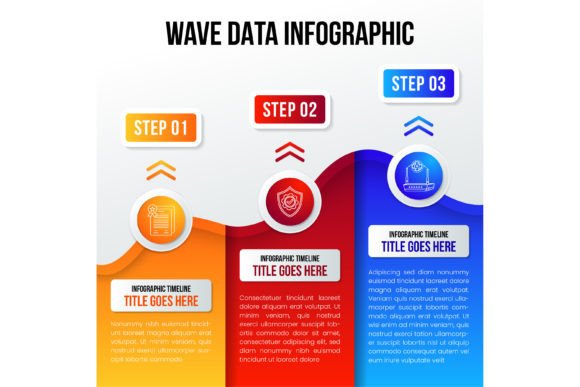
This article explores the strategic utility of using a minimal, three-step timeline infographic layout. By leveraging vector design elements, specifically those featuring circle-shaped icons and gradient wave motifs, businesses can transform static reports into dynamic storytelling tools. We will examine how such templates support long-term branding, enhance customer experience, and facilitate better internal planning, while also addressing the risks of deploying visual assets without clear contextual goals.
The Psychology of Visual Progression
Human cognition is wired to recognize patterns. When we encounter a timeline, our brains automatically seek a beginning, a middle, and an end. The Wave Data Infographic Timeline capitalizes on this innate preference for narrative structure. Unlike linear, rigid charts that can feel bureaucratic or dry, a wave-based design introduces a sense of flow and organic movement. This subtle psychological cue suggests that progress is natural and continuous, rather than forced or disjointed.
The use of a three-step timeline is particularly effective because it aligns with the cognitive limit of working memory. Most adults can comfortably hold three to four distinct concepts in their mind at once. By restricting the infographic to three key phases—whether they represent past, present, and future; problem, solution, and result; or awareness, consideration, and conversion—you reduce cognitive load. This allows the audience to focus on the quality of the information rather than struggling to navigate a complex diagram.
Furthermore, the integration of icons in circle shapes serves as visual anchors. Circles are universally perceived as complete, unified, and friendly. They draw the eye and create focal points within the broader wave design. When these icons are paired with concise text, they act as signposts, guiding the viewer through the narrative arc without requiring excessive reading. This is crucial in marketing materials, presentations, and web content where attention spans are fleeting.
Design Elements as Strategic Tools
The specific design features of this template—namely the red, yellow, and blue gradient wave element—are not arbitrary. Color psychology plays a significant role in how information is perceived. Blue often conveys trust, stability, and professionalism, making it ideal for corporate data and financial reporting. Yellow introduces energy, optimism, and attention, highlighting key transitions or opportunities. Red can signify urgency, passion, or critical milestones. When blended into a gradient, these colors create a seamless transition that mirrors the fluidity of business processes.
From a technical standpoint, the fact that this file is a 100% vector design with 300dpi high resolution is critical for professional application. Vector graphics ensure that the infographic remains crisp and legible regardless of scale. Whether you are printing a large-format banner for a conference, embedding a small icon in a newsletter, or displaying it on a high-resolution 4K monitor, the integrity of the design is preserved. This versatility eliminates the need for multiple design iterations, saving time and resources.
The square layout design offers additional flexibility. Square formats are increasingly dominant in social media feeds, particularly on platforms like Instagram and LinkedIn. A well-organized square infographic can stand alone as a post, be part of a carousel, or serve as a thumbnail for a video presentation. This adaptability ensures that your strategic message maintains consistency across various digital touchpoints.
Practical Applications Across Business Functions
Understanding the theoretical benefits of the Wave Data Infographic Timeline is only half the battle. The true value lies in its application. Here are several strategic contexts where this template can drive measurable results:
- Marketing and Customer Journey Mapping: Use the three steps to illustrate the customer lifecycle. Step one could represent "Awareness" (blue), step two "Engagement" (yellow), and step three "Conversion" (red). This visual simplifies complex funnel analytics for stakeholders who may not be familiar with technical marketing jargon.
- Project Management and Workflow Analysis: For internal operations, the timeline can map out key project phases. Instead of lengthy status reports, a single infographic can highlight the current stage, recent achievements, and upcoming milestones. This promotes transparency and keeps teams aligned on immediate goals.
- Educational Content and Thought Leadership: Educators and bloggers can use the template to break down complicated concepts. For instance, explaining a three-part economic theory or a historical sequence becomes more engaging when supported by clean, modern visuals. This enhances retention and positions the creator as an authoritative voice.
- Investor Presentations and Pitch Decks: Investors often skim through dozens of decks. A clear, visually appealing timeline that outlines your company’s growth trajectory, product development stages, or market entry strategy can make a lasting impression. The professional, minimal aesthetic signals competence and attention to detail.
Strategic Considerations and Risk Management
While the Wave Data Infographic Timeline is a powerful tool, it is not a panacea. Misuse can lead to confusion or dilute your message. One common risk is content overcrowding. Because the design is minimal, it requires disciplined editing. Attempting to cram too much text into the limited space around the circle icons will destroy the visual balance and defeat the purpose of simplification. Always prioritize clarity over comprehensiveness. If a step requires extensive explanation, consider using the infographic as a summary link to a more detailed report.
Another consideration is contextual relevance. Not every dataset benefits from a three-step wave structure. Complex, multi-variable data may require more sophisticated charts or interactive dashboards. Using a simple timeline for overly complex information can appear reductive or misleading. Before adopting this template, ask yourself: Does my narrative naturally fit into three distinct phases? If the answer is no, forcing it may obscure rather than clarify.
Additionally, brand alignment is crucial. While the red, yellow, and blue gradient is versatile, it may not match every corporate identity. The advantage of this template being editable in AI, EPS, and SVG formats is that you can customize the colors to align with your brand guidelines. However, changing colors arbitrarily without understanding color theory can disrupt the visual hierarchy. Ensure that any modifications maintain sufficient contrast and readability.
Implementation Best Practices
To maximize the impact of your Wave Data Infographic Timeline, follow these implementation guidelines:
- Define Your Core Message First: Before opening the design file, write down the three key points you want to communicate. Ensure they are distinct and logically sequential.
- Leverage Vector Flexibility: Use the included AI and EPS files to adjust shapes and icons. If your industry is tech-focused, swap generic icons for specific symbols like servers, clouds, or code brackets. This customization adds relevance and professionalism.
- Maintain Visual Hierarchy: Use font weight and size to distinguish between headings and body text. The icons should be prominent, but the text must remain legible. Avoid using decorative fonts that compromise readability.
- Test Across Mediums: Preview your infographic on different devices. Check how it looks on a mobile screen versus a desktop monitor. Ensure that the details in the 300dpi JPG export are sharp and that the colors remain consistent.
- Integrate with Broader Strategy: Do not treat the infographic as an isolated asset. Embed it within a larger narrative. Use it in email campaigns, annual reports, or website landing pages to reinforce a consistent message.
Long-Term Value and Brand Equity
Consistent use of high-quality visual assets contributes to long-term brand equity. When audiences repeatedly encounter clear, professional, and aesthetically pleasing infographics from your brand, they begin to associate your company with clarity and expertise. This subconscious association can influence purchasing decisions, partnership opportunities, and employee recruitment.
The Wave Data Infographic Timeline is not just a one-time design fix; it is a component of a broader communication strategy. By investing in editable, high-resolution templates, you build a library of assets that can be adapted for various needs over time. This approach is more sustainable and cost-effective than commissioning custom designs for every minor update.
In conclusion, the strategic adoption of visual tools like this infographic template empowers professionals to communicate more effectively. It bridges the gap between raw data and human understanding. By focusing on simplicity, flow, and visual coherence, you can transform complex information into compelling narratives that drive action. Whether you are a freelancer looking to enhance your portfolio, a small business owner aiming to improve client presentations, or a corporate marketer refining your content strategy, the intentional use of the Wave Data Infographic Timeline offers a pathway to greater clarity and impact.
Remember, the goal is not just to create something that looks good, but to create something that works. Let the design serve the strategy, not the other way around. With the right approach, this minimal, vector-based template can become a cornerstone of your visual communication toolkit, helping you achieve better results in an increasingly competitive digital landscape.